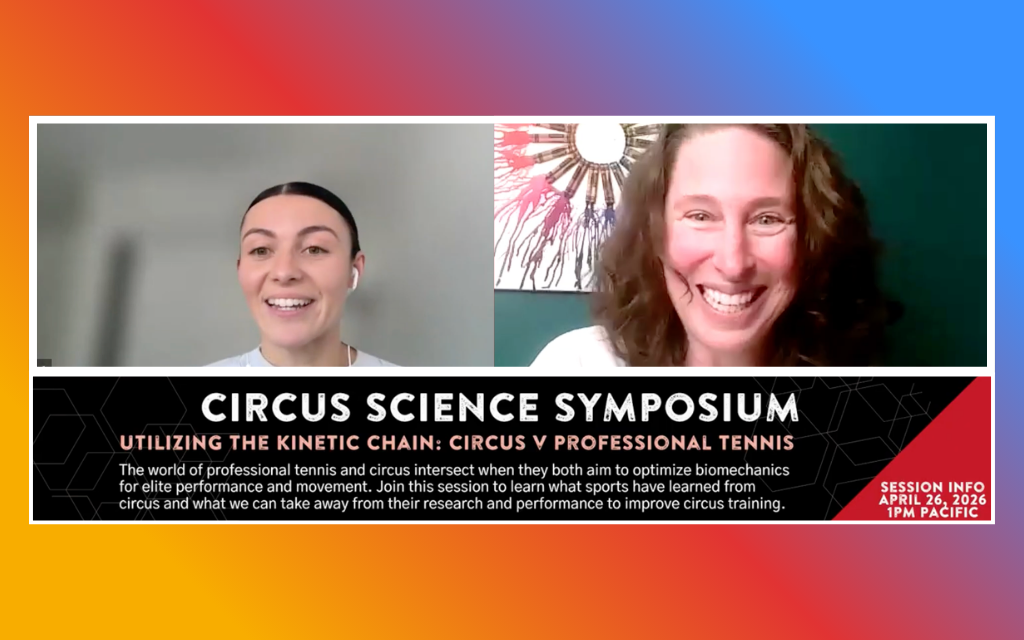
Before we get to what our experts want to make sure we’re not missing – Let’s celebrate what we’ve got! That’s what I hope to do as I highlight the speakers of the upcoming Circus Science Symposium.
If you haven’t heard about the Circus Science Symposium, it is a day full of nerdy circus science learning from renowned experts. (and it’s coming up soon!!!)
More and more we are able to form research backed opinions about how to do what we do, why we do it, where traditional wisdom is sage, and what needs an update. Circus science is evolving quickly and this is your opportunity to keep up.
So, in preparation for the symposium, I asked our speakers to share a common misconception or a piece of advice regarding what circus clinicians, coaches, and artists might be missing from their practice; their ideas were inspiring and meant to be put into immediate action.
Before we get to their brilliance, I would love to share my thoughts on the topic as I listened to what was behind what these speakers were saying.
Put simply, BELIEVE IN YOUR PATIENTS.
Believe them when they describe their symptoms. Validate what you hear and invite them to tell you more.
Believe in their goals whether that’s something ordinary or extraordinary. Recognize their goal may not match yours.
Believe in their ability to recover and excel in performance. The human body is so incredibly adaptable to stimulus. So much is possible.
Believe in their capacity to learn. Take the time to educate them and involve them in their process. Make them feel empowered with knowledge about how they can improve, not limited with disability.
Now to hear directly from our distinguished speakers from their niche and perspectives…
Each speaker was tasked with identifying the one critical insight they believe is most vital for training or clinical care. Here are some of the highlights!
Let’s start by addressing the most common fear when artists seek care, being asked to do a “hard stop” of all training, and the “all-or-nothing” approach to injury. Dr. Jennifer Zellers assured us that for the best tendon rehab “We probably shouldn’t be telling our circus artists to just stop doing circus. Often there are ways we can strategically dose activities for the right amount of load so they’re still training and performing as part of their rehab.” This sentiment is echoed by Hayley Ward who champions the concepts of movement optimism and physical literacy as essential tools for keeping circus and tennis athletes in a position where they can build confidence and see the journey to high-performance rather than sitting out on the sidelines. This shift toward smarter, more integrated training is further supported by flexibility specialist Dan Van Zandt who argues that the traditional separation between strength and flexibility is entirely artificial. “Flexibility and strength are part of the same essential practice which ultimately is progressive loading.” When we treat the body as a unified system rather than a collection of separate boxes, training becomes more efficient and works towards an artist’s longevity.
The message from these first few speakers is clear. Keep moving!
Expertise also may require an eye for clinical nuances that are frequently overlooked either because of cultural norms or due to blind spots in our training. Dr. Brooke Winder suggests we may need to learn to bypass the cultural discomfort of discussing pelvic health by integrating screening questions directly into intake forms. This will open the door to conversation, help broach the topic, and signal it is acceptable to talk about pelvic concerns. Dr. Linda Blustein, highlights an educational blindspot by correcting a misconception about hypermobility and Postural Orthostatic Tachycardia Syndrome (POTS): “You don’t have to faint” to be struggling with autonomic dysfunction. Signs as simple as fidgeting in line can be vital diagnostic clues as this may be a coping mechanism to improve systemic circulation.
Marlo Fisken wants us to remember that physical insights are only as effective as the language used to deliver them. As an artist and instructor she wants to highlight that clinicians are educators whose words change the way artists think about their own bodies and “come out in the way patients then talk to their own clients,” giving every clinical interaction a lasting ripple effect across the community.
Finally, we must recognize that the onus of wellness cannot fall solely on the performer. Dr. Laura Adams advocates for a shared ecosystem where artists, coaches, and care providers work together. Performance excellence and psychological wellbeing are mutually reinforcing. When we move away from isolated silos—whether in training, diagnostics, or advocacy—we create a culture that is not only more efficient but more respectful of the artist’s long-term sustainability.
These contributions represent a call to direct action, asking us to work together for the future of circus medicine and performance.
Join me in learing more from these brilliant speakers who believe in optimizing artist performance everyday the studio and the clinic and all the way to the stage.
I absolutely loved spending time learning from these speakers and I am thrilled I get to share a little bit with you today (and look for more next week!)
Let’s continue to learn more next weekend at the Circus Science Symposium. Let’s all go deep into the circus science and come out a stronger team on the other side.
See you in there
👋 Emily