
I’ve been working with circus artists for over 30 years. First as a coach and now as a clinician and it shouldn’t surprise me that things change, but wow do they. Circus has definitely become more popular. Trends in disciplines change the demographics of circus. Knowledge has grown dramatically and skills are far beyond where we could have imagined. And, Teaching and instructor education has expanded. And with all that circus bodies, challenges, and injuries have evolved.
This is what I have been pondering in the last year or so as I watch how the areas of strength and coordination patterns of the artists in my clinics have evolved.
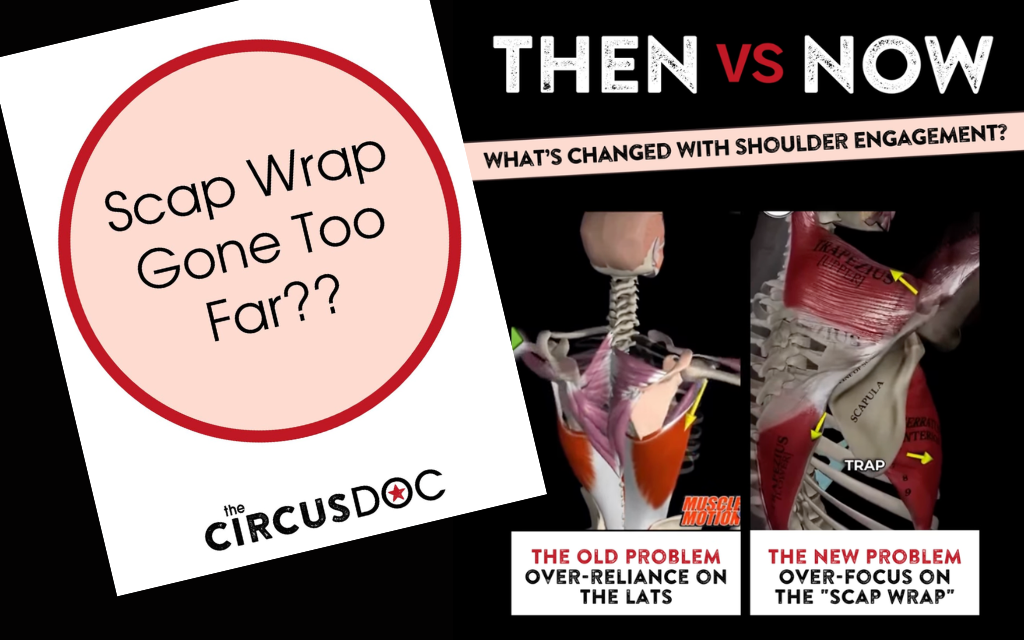
Often when aerialists came into my clinic with shoulder pain one of the most common reasons was their interpretation of the cues meant to help them stabilize their scapula by pulling their shoulders down away from their ears. Their lats were dominating over their ability to stabilize from the parascapular musculature.
Now, yes, I still see that pattern, because let’s face it, the lats are a big HUGE muscle and easier for aerialists to find and recruit.
Also yes, aerialists still come into my clinic with shoulder pain that I think can be traced back to them trying hard to achieve that “perfect” form, but now I am seeing a whole new and interesting pattern. This one is a bit less predictable in presentation of pain symptoms but equally as before very predictable in presentation of movement patterns.
These artists are coming in after working hard to get their “scap wrap” that awesome motion of the scapula around the ribcage into upward rotation and posterior tilt meant to align their glenoid with their humerus.
I know, your thinking… Emily, I’ve heard you talk about that before. You love the serratus. This is what alignment needs… What’s the problem?!?
The problem is, scapular stability is three-dimensional and like most things when it comes to humans, complex.
Scapular wrapping is only part of the equation. The scapula needs that pull around the ribcage with firing of the serratus (we’ve talked before about the pecs vs serratus challenge in this blog post) balanced with the pull back towards the spine of the middle and lower trapezius. That “force coupling” is what gives the aerialist the best possible scapular positioning with the arms overhead. This is important as it acts as the stable base for the rotator cuff to pull from and enables the transfer of force through the shoulder and into the trunk. And that transfer of force through and not into the joint is what keeps the very mobile shoulder happy.
So, what should we do about it?!?
First off, YES, keep wrapping… but also remember that the muscles between the shoulder blades need to be working too. The inferior angle (bottom of the scapula) should be drawing around toward the armpit as the arms go overhead but also the top inside edge of the scapula needs to be drawing towards the spine.
Artists should feel work in their armpit area AND between their shoulder blades.
Nuance is never popular on the internet, but nuance is where human magic occurs.