
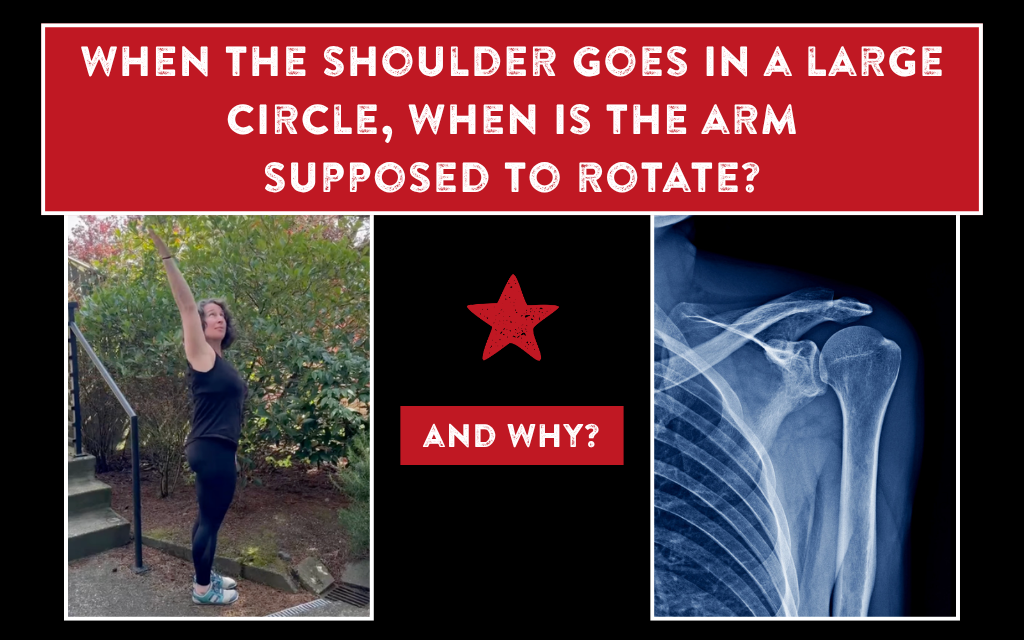
Last week I was working with a patient and they stopped me and asked if they could ask a question… The answer is always 100% heck yes.
The question was such a fun one that I wanted to share it with all of you.
They asked, “When the shoulder goes in a large circle, when is the arm supposed to rotate? And why?”
This is fantastic because it is nuanced and takes the anatomy of a shoulder and puts it in action.
Let’s dive in and discuss!
Check out what happens when I go through shoulder circumduction by circling my arm.
Note that as my arm goes overhead, my humerus is in external rotation with the thumb pointing towards the back. If I keep the humerus in this alignment it will stop moving – try it yourself.
Once I hit that point I internally rotate the humerus and the arm moves slightly out into abduction to move into the backside of the circle.
When I reverse the motion, my arm moves behind me leading with the pinkie in internal rotation. Again, if I keep this orientation the arm will stop. So I have to externally rotate the humerus to bring the arm overhead.
All of this is what my patient had observed in herself and other artists, and she wanted to know why!
The answer lies in the shape and interactions between the scapula, the rib cage, and the humerus itself.
As the shoulder itself is a ball and socket joint, you might think it should just be able to move freely in a circle. However, the joint doesn’t exist in isolation and the shape of the scapula with the acromion above would not allow it to happen… so the shoulder blade will have to move too… but how?
The mobility of the scapula allows us to move the acromion out of the way and point the glenoid (the joint surface of the shoulder) almost any direction, but once again there are limitations as the scapula sits on the backside of our ribcage.
The roundness of our ribcage means that the scapula has to be maneuvered through tilts and rotations in all directions to accommodate shoulder circumduction. It’s quite an amazing feat and is why it is a good thing that the scapula sits in the middle of a lot of muscle (17 attach there!!!) with only one bony joint at the clavicle.
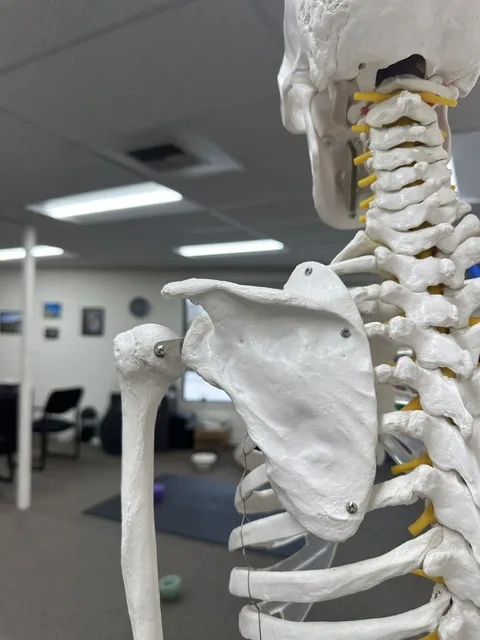
So, the rotation of the arm is the part we see, but the tilt and rotation of the scapula is what really dictates what’s happening.
Now let’s get super nerdy and break it all down
As the arm passes through full flexion overhead and then moves behind the body during circumduction, the humerus and scapula undergo a complex sequence of coordinated movements that reverse and transition through different patterns.
During Full Flexion (Arm Overhead): At maximum flexion, the scapula reaches its peak upward rotation, internal rotation, and posterior tilting position.[1][2] The humerus simultaneously achieves significant external rotation relative to the scapula—approximately 34 degrees during overhead positions.[3] The humeral head translates anteriorly on the glenoid during flexion.[4] The scapulohumeral rhythm ratio during forward flexion may be slightly less than the standard 2:1 ratio we learned in school. While that number seems to hold approximately true, dependent on human variation for abduction and scaption, a small study found the ratio to decrease as the plane of motion moved anteriorly and became 1.1:1 in flexion, meaning the glenohumeral joint and scapula contributed nearly equally to the overhead position.[5]
Transition from Flexion to Extension (Moving Behind the Body): As the arm begins to descend and move posteriorly during circumduction, The humerus undergoes internal rotation as it moves behind the body, reversing the external rotation that occurred during the overhead phase. At the glenohumeral joint, the humeral head translates posteriorly during extension, the opposite direction from flexion.[4] The scapular movements reverse and begin anteriorly tilting, downward rotation and external rotation, reversing the upward rotation pattern seen during elevation.[6][7] Finally, during the last 30 degrees of shoulder extension, as the arm approaches the body, the scapula tilts posteriorly.[6]
This transition demonstrates how the shoulder complex adapts its movement strategy depending on arm position. Throughout this entire arc from overhead to behind the body, both bones continuously adjust their positions to maintain optimal joint mechanics and prevent soft tissue compression.
References
- Three-Dimensional Shoulder Kinematics: Upright Four-Dimensional Computed Tomography in Comparison With an Optical Three-Dimensional Motion Capture System. Yoshida Y, Matsumura N, Miyamoto A, et al. Journal of Orthopaedic Research : Official Publication of the Orthopaedic Research Society. 2023;41(1):196-205. doi:10.1002/jor.25342.
- Scapular Positioning and Movement in Unimpaired Shoulders, Shoulder Impingement Syndrome, and Glenohumeral Instability. Struyf F, Nijs J, Baeyens JP, Mottram S, Meeusen R. Scandinavian Journal of Medicine & Science in Sports. 2011;21(3):352-8. doi:10.1111/j.1600-0838.2010.01274.x.
- In Vivo Kinematic Analysis of the Glenohumeral Joint During Dynamic Full Axial Rotation and Scapular Plane Full Abduction in Healthy Shoulders. Kozono N, Okada T, Takeuchi N, et al. Knee Surgery, Sports Traumatology, Arthroscopy : Official Journal of the ESSKA. 2017;25(7):2032-2040. doi:10.1007/s00167-016-4263-2.
- Translation of the Humeral Head on the Glenoid With Passive Glenohumeral Motion. Harryman DT, Sidles JA, Clark JM, et al. The Journal of Bone and Joint Surgery. American Volume. 1990;72(9):1334-43.
- Effect of Plane of Arm Elevation on Glenohumeral Kinematics: A Normative Biplane Fluoroscopy Study. Giphart JE, Brunkhorst JP, Horn NH, et al. The Journal of Bone and Joint Surgery. American Volume. 2013;95(3):238-45. doi:10.2106/JBJS.J.01875.
- Scapular Motion During Shoulder Joint Extension Movement. Shirai T, Ijiri T, Suzuki T. Journal of Biomechanics. 2024;166:112019. doi:10.1016/j.jbiomech.2024.112019.
- Scapular Kinematics During Unloaded and Maximal Loaded Isokinetic Concentric and Eccentric Shoulder Flexion and Extension Movements. Wochatz M, Rabe S, Engel T, Mueller S, Mayer F. Journal of Electromyography and Kinesiology : Official Journal of the International Society of Electrophysiological Kinesiology. 2021;57:102517. doi:10.1016/j.jelekin.2021.102517.
WANT TO LEARN MORE?
These once-yearly courses with The Circus Doc are made for you.
Join the waitlist NOW to take your circus knowledge to the next level!
–
Circus Fusion: Circus Medicine Education {Care Providers}
Circus Smart: Instructor Boost {Circus Instructors}